
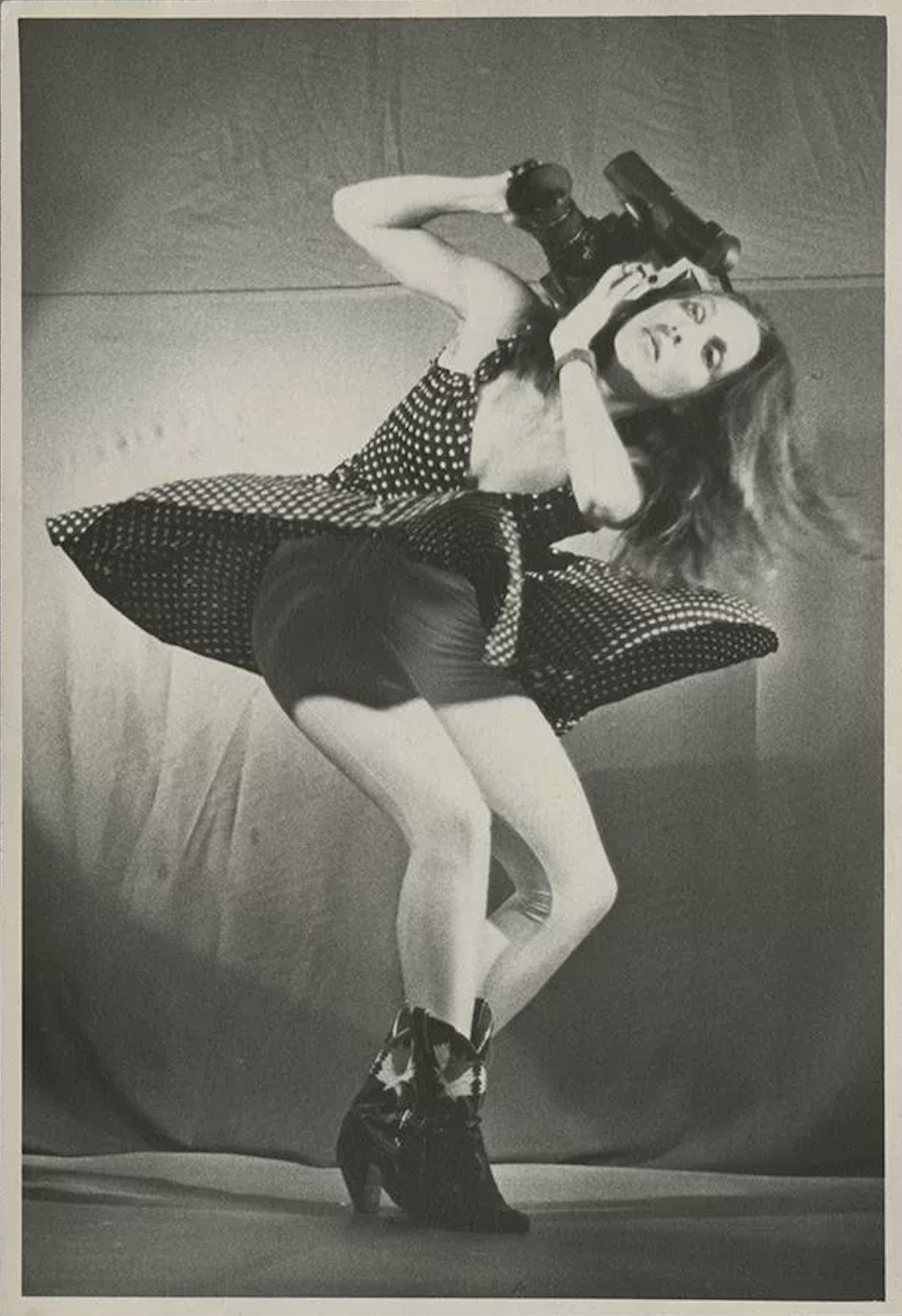
Pola Weiss: Woman with a Video Camera
How many colors are there in a field of grass to the crawling baby unaware of ‘Green’? How many rainbows can light create for the untutored eye?
― Stan Brakhage
Since the very early experimentation with moving images, there has been a quest for a pure language, beyond the limits imposed by the written word. From Dziga Vertov’s ‘Man with a movie camera’ (1926) where cinema is presented as the axis around which the visible world is organized, to Stan Brakhage’s becoming-plant or becoming-insect exercises such as ‘Mothight’ (1963) or ‘Garden of earthly delights’ (1981), experimental expressions of the audiovisual have always sought the communicative and affective possibilities of the moving image as a means of challenging the limits to perception imposed by Language.
Furthermore, this experimentation implies a political stance that challenges the industrial and commercial nature that Cinema with a capital C has acquired, circulating in the form of high-budget, fiction films. The Vertovian mottos of the avant-garde kino-eye dream ‘explode art’s Tower of Babel’ and ‘down with the fairy-tale bourgeois script, long live life as it is!’– reflect that this quest for an-other visual form of communication, one that steps away from theater and literature, is actually as old as cinema itself.
Around the world, during the second half of the 20th century, the likes of Maya Deren, Jonas Mekas, Barbara Hammer, Nam June Paik, Harun Farocki, and many more, became prominent figures of the experimental audiovisual. Either coming from a film or television background, these artists persevered in this pure language quest, using the new technologies available to them. Particularly in Latin America, many women found tools such as the magnetic tape and the portable video camera technologies that could be held closer to their bodies, they could be literally turned towards them, as opposed to the highly techno-scientific phallic apparatus that was (is) the movie camera. This gesture gave us Cecilia Vicuña in Chile; Leticia Parente, Sonia Andrade and Anna Bella Geiger in Brazil; Sandra Llano-Mejía in Colombia and, in Mexico, the indisputable pioneer of videoart is Pola Weiss.
Deeply influenced by the Fluxus movement she witnessed in New York, the communication theory she studied in university and the amateur photography and videography of her father Leopoldo –Polo– Weiss, Pola was the first person in Mexico to use video as a form of artistic expression. Moreover, she was the first person to graduate from the prestigious UNAM (Autonomous National University of Mexico), where she was later a teacher, handing in a video-thesis, instead of a written one. There is a key message in this gesture: a video, a work of juxtaposed moving images, can count as a written piece; it contains ideas, even philosophical and theoretical thought.
‘We cannot limit ourselves to the word’, would be a common phrase used by Pola Weiss to explain her work. In a letter written to her father for her piece Autovideato (1979), she states: “You might think that all that money invested in my education was for nothing, given that I haven’t turned into an eloquent intellectual who can dazzle people with her speech.”
Her work is characterized by integrating this pure language quest of the moving-image to share a re-coded and re-packaged set of very personal stories of her bodily experience as a woman. In Ciudad-Mujer-Ciudad (1978), Pola relates the female body to the city of Mexico, one that is filled with traffic, inequalities and is literally sinking below our feet. The crucified woman in the video is a direct reference to her grandmother, whom she admired deeply and from whom she learned to love the creative activity of collaging. ‘It is very interesting because we usually relate “woman” to nature, not to the city’, reflects the feminist artist Mónica Mayer about this pioneering work by Weiss.
Mi corazón (1986) is undoubtedly her most celebrated piece, fusing the tragic devastation of Mexico City during the 1985 earthquake, to the personal emotional devastation she experienced after the unexpected ending of a desired pregnancy. The impossibility of motherhood is a constant theme throughout her work; she even created these pieces along her ‘escuincla’, as she would call her video camera, a Mexican expression that comes from Náhuatl, which could be translated to “child” (or, in some regions, also “puppy”).
Pola Weiss’s defense of the integration of video technology to her own body comes quite a few years before Donna Haraway’s publishing of the Cyborg Manifesto (1985), and also echoes Vertov’s preaching of the inclusion of cameras and moving images into everyday-life. This is probably why many people often cite Weiss’s work as a precursor of the moving-body-image expressions in social media, particularly tik-tok, where dance, video and the everyday are key elements of expression and memeification.
However, it is urgently necessary to distinguish that Pola’s work is categorically different to what happens within the logic of the algorithm. Nowadays, people adjust their own creativity to fit the possibilities given by a certain number of filters, aspect-ratios, and other technical limitations. Whereas, what she did back in the 70s and 80s was deliberately dynamiting the audiovisual apparatus. She would cross cables, take colors out or range, use a public medium to express private concerts; thus, subverting the ideological medium of television.
The avant-garde dream of Vertov canonically failed; although people today create movies everyday with their cameras, even though these cameras are closer and more integrated to our bodies than ever before (in the form of smartphones), and even as we have certainly incorporated this technology to our everyday lives, this action serves a purpose that is the diametrical opposite of bringing about the revolution: it only feeds the circulation of images that creates profit to tech billionaires. As Guy Debord famously declared, in the society of the spectacle we see “capital accumulated to the point where it becomes an image”.
Yet if it was ever alive, this Vertovian spirit of spontaneous art-creation, this playful research to discover what can be said through images, this undoing of the written language, this defense of a cyborg body by becoming a woman-camera, and this political potential of moving image art, it was certainly through the bold, passionate, unrepeatable and visionary art of Pola Weiss.
Alejandra Arrieta
Notes
1 Stan Brakhage, Metaphors on Vision, ed. P. Adams Sitney (Nueva York: Anthology Film Archives y Light Industry, 2017)
2 Dziga Vertov, Kino-Eye: The Writings of Dziga Vertov, ed. Annette Michelson, trans. Kevin O’Brien (Berkeley: University of California Press, 1984)
3 Quote from Pola Weiss (2023) Documentary film directed and produced by Alejandra Arrieta; distributed by Daimon.
4 Research for the documentary revealed that the shot of the tombstone below the woman’s feet is of her grandmother María’s grave.
5 Pola Weiss (2023)
6 Debord, Guy. 1995. The Society of the Spectacle. Translated by Donald Nicholson-Smith. New York: Zone Books.